Sunday, April 6, 2014

2nd Two in Cappadocia

Waiting in the Kayseri bus station for our 9 pm overnight bus back to Istanbul, Cappadocia is gradually receding into dream memory status. Everything turned out to be easy and hassle-free, with just enough of the modern world to keep us in contact with our home base, but I don't remember seeing a TV in three days! There was certainly none in our room (and we didn`t have to pay extra for that convenience!), none in the restaurants; none in the fast food establishments. Note that fast food in Cappadocia consists of a man making a sandwich from scratch for you. Even in a more updated city like Kayseri, the national fast food chains offer healthy, tasty food for the Turkish pallette, e.g. chicken kabob on Turkish bread (no whole wheat...), with onions, cabbage, rice pilaf and an Italian pepper on the side. Water (Turk. "Su") must always be purchased. And the home-made jams were so good at our hotel in this country where dried fruit appears to have been invented, that I ate too much of it the first morning we were there, and developed the sniffles by the third day from the sugar.
So yesterday we visited the famous "underground cities." These were actually huge multi-story shelters for entire regional populations to keep them safe for up to six months from invaders. They went as deep as eight six-foot stories, with hewn-out cublicles for each family, communal rooms for each social class, water supplies, waste disposal, ventilation, and a church during Christian times. But the original underground cities go back 4000 years and more. The volcanic tuff (or tufa) is soft enough to carve into rather easily. In one of them there were two stories dug when the Christians arrived, and they added 4-5 more. They were sealed with 8-ton doors in the shape of a 6-foot diameter while, like a grind stone on its edge, which could be rolled on a track through a fitted slit in the rock, and which could not be budged from the outside. Lookouts gave news of the presence or departure of the invaders. The cities were even connected by tunnels 10 km long and more, rather dismal passages one had to negotiate in a crouched position the whole way.
Leaving the second underground city we headed for the gorge of Ihlara, a 14km long river gorge with 100-foot walls, into which are carved refuges, dwellings and small churches, some with elaborate frescoes. One is always in search of frescoes in these 6th to 9th century remnants of early Christianity. Unfortunately most of them out in the "wild," that is, unrestored and unprotected, are heavily defaced, with the grafitti of ages. It was a delightful hike through this magical gorge, and we turned around after 4 km. Then we jumped in our car and headed for the other end of the gorge, the town of Selime, that boased a "troglodyte village." This was a number of dwellings carved into the conical rocks, including a church with simple and mostly effaced linear frescoes, none of the polychrome storytelling we had seen at the Goreme Open-Air Museum the day before.
To be continued.

Friday, April 4, 2014

Cappadocia, First Full Day Begins with Balloon Ride

I had made the reservation in early February, choosing the deluxe ride, 1.5 hours, but I was the only one for that ride this morning, so they asked me to take the standard one-hour ride, which turned out to be plenty.
But it was thrilling.
They picked me up at 5 am sharp, provided a minimal breakfast, and took us out to the site, where the balloon was filling with hot air. I was with 8 other passengers, all from Jakarta. We were crammed in rather tightly, but we got along fine, and I managed to switch positions half-way through the flight.
We were aloft before dawn, along with about 50 other balloons.

As the sun rose,  it dramatically illuminated the pinnacles on the ground.

We drifted over this incredible terrain in silence except for the periodic roar of the burner, and the end of an hour, our pilot Mustafa, landed us softly on the back of the company's flatbed truck. Mimosas and flight certificates awaited us on the ground, and I got back to the hotel by  8am in time to join Barbara for a REAL breakfast, with two cheeses, three marmelades, a cheese-filled pancake and halvah--a bit sugar-heavy for my habits, but I took it as a celebration of finally having arrived in Cappadocia.


We were out by 10am and gave ourselves the task of covering the Urgup-Goreme-Love Valley-Cavusin-Pasabaglari circuit, directly to our north, that included dozens of pre-1st millenium churches carved out of the soft tuff rock, and cap rocks and pinnacles of a distinctly phallic cast (hence "Love Valley") ending up exhausted in Urgup for an exceptionally good dinner at Somine, 

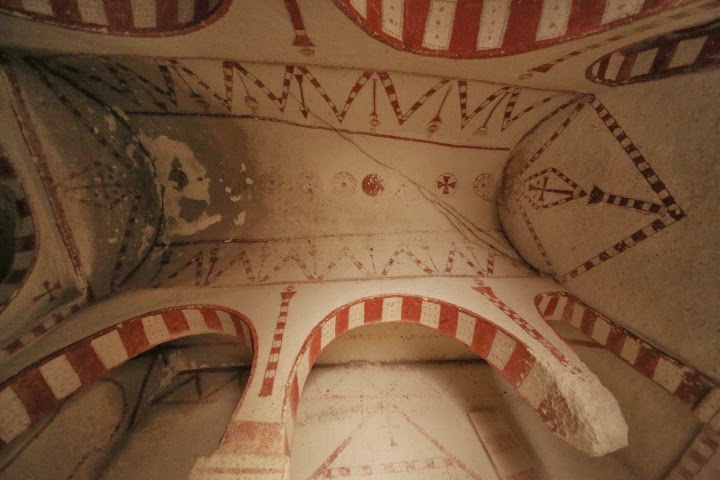
5th to 7th Century churches carved out of the soft tuff rock, decorated in frescos, many of which were defaced, presumably by the Turkish invaders.


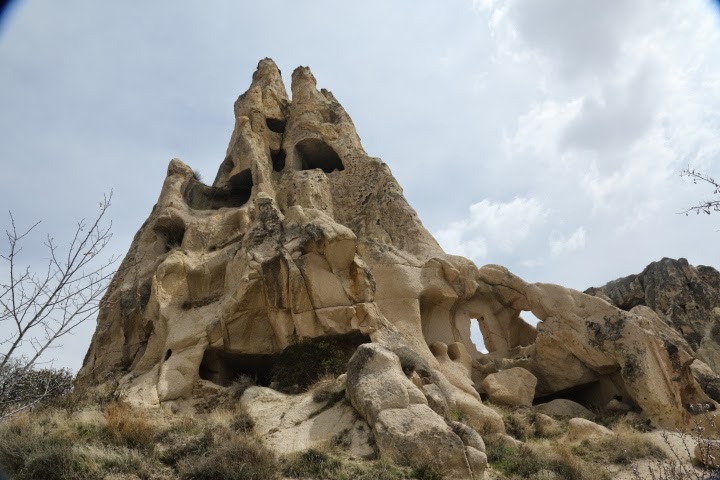
One of the natural structures of the Goreme Outdoor Museum, a walking circuit of early churches all in the same park-like area.

One of the outstanding frescoes at the Goreme Outdoor Museum.

Prominent examples of the pinncles of Love Valley, which we dubbed the Five Horny Imams:


Thursday, April 3, 2014

Relics

Thursday, April 4
Relics
In case you were wondering what happened to Moses' famous staff, the one that turned into a
snake that ate the snakes of the staffs of Pharoah's magicians, I saw it yesterday(13th Century). It's one of the relics
enshrined in Istanbul's Topkapi museum, the former Sultans' palace and compound, Turkey's version
of the Louvre or the Forbidden City. And that same room also houses the "Prophet" David's sword (10th
Century BCE) with a metal tablet purporting to offer authentication in a language entirely strange to me;
and the "Prophet" Joseph's turban (14th century BCE), exceptionally well-preserved for fabric--and
who knew he sported a turban? There's also a footprint of the Prophet Mohammed, in what looks like
glazed mud. Topkapi consists of a sprawling walled compound, pleasantly landscaped with masses of tulips
grouped by color, and fragrant hyacinths, within which are a variety of buildings housing the treasures,
that one visits by following the crowd around, looking into recessed glass display cases. From the bejeweled
items one sees there in profusion, it's clear that the Sultans denied themselves nothing, and one
speculates that the "sick man of Europe," the Ottoman Empire, choked on its gemstones.
Hagia Sophia was both magnificent and deeply moving. One of the great architectural creations of the
earliest Middle Ages (the present building, the third version of it, dates from the 6th century CE) it retains
its solemnity, while displaying none of the decorative excesses associated today with the Eastern Orthodoc
Church, its direct descendant, although much of the original decor is gone. Kemal secularized it in 1935--the
Turks had made it a mosque after the conquest in 1453. Kemal's seated statue glowers over the adjoining park.
Islamic piety is quite in evidence, however. The magnificent Blue Mosque, part of the same complex,
issues you plastic bags for your shoes and a sky-blue cloth to women for a head covering, and has a
separate entrance for tourists from the one reserved for the faithful who've come to pray. Also, one
hears the call to prayer sung out over loudspeaker several times a day.
The local people were quite cordial. Merchants, of course, declared themselves our friends and guides, until
the moment when we said we weren't interested in visiting their shops. But those whose cafes or
restaurants we did patronize became our putative lifelong buddies. We snacked at a cafe overlooking the Blue
Mosque on one side and the Sea of Marmara on the other, both views unobstructed, and we dined
in the rich decor of a excellent restaurant, whose owner also had a business making and restoring
carpets. He had shown us his balcony earlier in the day--more great views.
After dinner we found our way back to our hotel after going in circles a few times, but finally were helpe
by a man towing a huge two-wheeled cart, fully loaded, and who refused a tip. Then we took a cab
to the bus station and boarded our midnight bus for Kayseri, near Cappadocia. Sleeping on it was more
comfortable than the airplane, since we had  more room. We arrived at 1:30 Thursday, and were met
by our car rental guy, with our car, which we drove to Urgup, a beehive of tourism, and full of the typical
rocks of Cappadocia, with dwelling carved into them, only to find that our hotel, The Old Greek House,
was a further 5 km down the road in the village of Mustaphapasha. I insisted on keeping our
reservation, and it was well worth it: it's an 18th century palace turned guest house, with rustic decor and
fabulous meals. Martha Stewart stayed there in 2010.

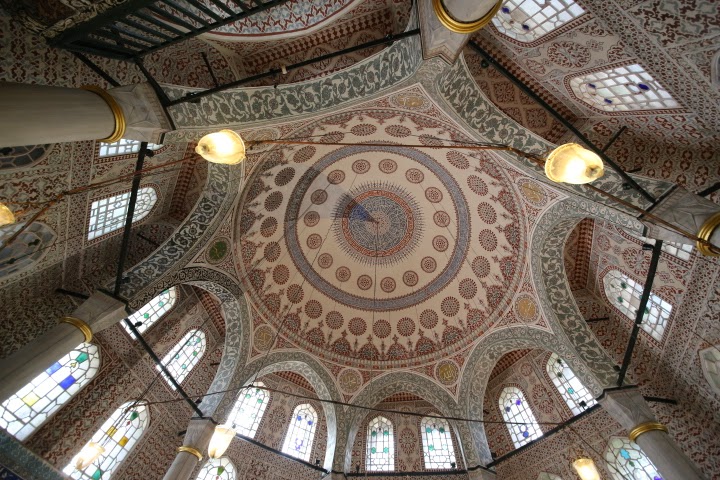
The Blue Mosque, ceiling

Hagia Sophia

Hagia Sophia

On Uncle Kemal's knees

Blue Mosque, after dark
Lunch at a rest stop outside of Kayseri
Old Greek House, Mustaphapasha, Turkey

Wednesday, April 2, 2014

Istanbul! We Both Got Here!

I left the house by cab for the train station at 2:15 and got to JFK by 4:15--easy. The plane was supposed to take off at 6:50, but we didn't leave the ground until 9:38, arriving at Ataturk Airport in Istanbul at 2:38pm the next day, local time. I had managed to watch "The Best Exotic Marigold Hotel" in two shifts, with about 4 hours of fitful sleep, always in search of a comfortable position. The movie was extremely apt, for reasons I'd realize later. Service and food were excellent on this Turkish Airlines flight, and they trumpeted their award as the "Best European Airline" on their menu (!).
But the waiting ordeal had just begun. I had imagined that I could run into town and see the Archaeological Museum and return to the airport by 6 in time to meet Barbara, who was supposed to arrive at 5:15 (and then go through customs for 45 minutes). But her plane turned out to be more than 6 hours late. I was getting smellier and smellier and more and more tired as I tried in vain for 4 hours to find out when her plane was expected to arrive. But her London originating flight was just marked "Delayed" in English and Turkish for hours; no one knew anything. Finally at about 10pm her expected arrival time showed up as 23:29, or about 11:30 pm. We had agreed we would take an overnight bus to Kayseri that night to begin our visit to Cappadocia, but no one in the airport had a bus schedule, so at about 8:45 I decided to take the metro to the Otogar, or bus depot, to find out. 
I grabbed all three of my bags, plus my plastic food bag, and off I went to the metro, bearing one backpack and dragging two rolling bags, one quite large. Inside the subway train the bigger one at 28 inches, kept keeling over, and I was glad it didn't hit anyone. When I got to the stop two young men tried to take my luggage, asking me my bus destination. I held onto it for a while, while they led me to the bus company that served Kayseri. I had expected a centralized depot. Instead, it was a row of colorful storefronts, so it turns out the two young men were actually helpful. Inside I found out that there was a midnight bus, arriving in Kayseri, Cappadocia, at 10 the next morning. The owner begged me to leave my two rolling bags with him, but I wouldn't think of it, since although Barbara's arrival was predicted at 11pm, I had no assurance that she would be her by then.
The two young men escorted me back to the subway station, repeating "baksheesh, baksheesh," and I assured them that I understood that a tip was the whole point of the exercise. However, I had no small bills, and only one Turkish lira in change, plus my return subway token. 
"No problem, no problem," they said when I revealed that my smallest bill was a 50 lira note, about $27. "Change, change," was their other English word. They offered to give me 30 lira in change, but I refused. Then they found a friend who contributed an additional 10 lira in coins, but I still refused. None of the merchants we tried in the metro station had change for the 50, so I had to give them the subway token (worth 3 lira) and the 1 lira in coins. The meaner of the two then shook his fist and scowled at me; I had betrayed them, but they had also left me with the necessity to find change for my 50. In the rear of the station a merchant took two 20s and a 10 out his wallet for my 50--the token machines wouldn't take anything larger than a 20, so I could buy my token.
Back at the airport by 10pm, Barbara's plane was finally announced at 23:29. By 11, I had decided to change our car rental reservation in Kayseri, moving it up a day, and to find a hotel in Istanbul, which I did with my Rough Guide to Turkey in my Kindle viewer in my tablet--a boutique hostel-hotel in the Sultanahmet district, where the main historical buildings were located--Hagia Sophia, the Blue Mosque, etc.
The announcement that Barbara's plane had landed came at 11:11. Now it would take her 45 minutes to get through customs. I had been calling and texting her for the past six hours, but with no response. I got up to wait with all the limo drivers at the arrivals door at about 11:30. By midnight she still hadn't appeared. I was beginning to wonder if I could do the trip on my own, if it had all been a hoax; I was extremely tired and smelly, but I did manage to banish those thoughts. 
Then, finally, after seven and a half hours in the airport, she appeared. We recognized each other immediately and greet each other like old friends. The trip would go on as scheduled (more or less--given uncertainties like today's). She changed money, and we headed for the metro, but were met by a kind taxi driver who informed us it was closed for the night. He offered to take us to our hotel for 65 lira, and we jumped at it.
We sped through the city, with the Sea of Marmara on our right, and the very European lights of the city on our left, passing through the ruins of Constantinople's fortified wall, and arriving at the Big Apple Hostel-Hotel on a sloping street within view of Hagia Sophia's minarets. The young proprietor's name was Apo, hence the name, and he was right out of "The Best Exotic Marigold Hotel," and here we were, past retirement age (though still working our asses off) having just met on the physical plane, and sharing a room with two beds. 
I set my camera up on the rooftop terrace before showering off the sweat of the voyage, while Barbara went directly to sleep. It was delicious extending my legs in a real bed.

The minarets of Hagia Sophia from the hotel terrace:

This morning dawned overcast, but I had gotten a good night and morning photograph from the same position. I took my camera down at 7:50, and then went back to sleep. The breakfast, which we at at 9:30, was quite extensive.

The view of the Sea of Marmara from the hotel cafe, with Barbara working on her blog in the foreground (rtwin70days.com).
 

Saturday, March 29, 2014

Gifts for Mongolia

Once you get outside the cities in Mongolia you run into the tents of the nomadic population, known as gers or yurts. As a traveler you are expected to enter such tents without waiting for an invitation, and partake of whatever food is out. In announcing yourself you should say "Nokhoi Khor," which means "Hold your dogs."
But you are expected to bring gifts.
So yesterday I stopped at a dollar store and loaded up with $25 worth of gifts: pocket knives, decorative nail clippers, transparent soaps, and laser stickers for the children. Here they all are laid out on my bed at home:
Above the gifts you can see the tablet on which I'm writing, my toiletry kit, journal and other sundries. In the middle is a map of Mongolia.


Monday, March 24, 2014

Departure in One Week, Destination: Istanbul & Cappadocia

I leave March 31 and arrive in Istanbul at 11:40 am the next day. Barbara gets in at 5:15 pm. So I plan to run into town and visit the Archaeological Museum, then run back to the airport to greet her—it will be our first face-to-face meeting. I think she's taller than I am.

Then we'll want to get from Istanbul to Cappadocia and not spend a day doing it, nor spend the money on a flight. So we plan to go overnight. Most people take the bus, but there's also a train with sleepers and couchettes. They go to Kayseri, the largest city in that area. Why don't most people take the train, which is much more comfortable? Probably because the train station lies on the other side of the Bosphorus, the waterway the separates European Istanbul from Asian Istanbul. The main airport and the main attractions are on the European side, and you have to take a ferry to get to the Haydarpasha terminal on the Asian side—as my Turkish friend in New York told me. Good to know. 

Here's a map that explains things:
 
The terminal serves the ferries and is also a train terminal, one of the busiest in Europe and Asia. We'll catch the train that leaves after midnight and gets there the next morning.

Friday, March 7, 2014

Another reason why I'm going round the world...

I've just spent two days at art fairs in New York, and tomorrow I'm going to the Armory Show—59 "modern" dealers (20th Century), and 146 "contemporary" dealers. Ken Johnson in today's New York Times notes that the typical artist in the contemporary section—in contrast to the wide variety in the modern section—is "a canny juggler of ready-made signifiers. Everywhere you look, you see artists mixing and matching generic styles, images and devices in the forms of photographs, paintings, high-tech simulations and myriad nontraditional materials, sometimes using all these at once." (p. C31) He later mentions the "strange feeling of no context that prevails in contemporary art." This engenders a similarity of style between the art from cultures as diverse as China and the U.S. The Internet is ubiquitous and everything is pretty much available to everyone. Does this mean national styles are becoming as extinct as so many animal species driven out of their habitats by deforestation and agriculture?

In my own wanderings so far today and yesterday, I see lots of cleverness, lots of manipulation of cultural tropes, but very little of the world outside the U.S. and European cultural merry-go-round (the exceptions were by African artists). You see a lot more of the outside world at photography art fairs, and one of the reasons I'm going on this trip is to bring some more of this outside world home. It's astonishing how global-parochial we have become, imagining that our Internet connections and mobile devices actually bring us the diversity of the real world to our screens large and small. Of course, popular culture (including sports) can and does entire fill the minds of most Americans. Brief cultural forays outside it on a PBS station or serious play or documentary bow to the wide world outside, but most of us still live culturally within a cocoon inside a box inside a room. I'm traveling to get outside this room, and to bring back as much direct testimony and as many truthful and powerful images as I can, which is, of course, the royal province of Photography.

Please remember to visit my Indiegogo site, http://igg.me/at/marvels2014/x/6154797