Tuesday, April 15, 2014

Petra: Foreshadowings of the Modern

At various times in history art or architecture has been produced that resonates surprisingly with the modern sensibility. Think of the stylized forms of Neolithic sculpture, following the long period of Paleolithic mimetic art. Think of Arcimboldo in the 16th Century or the psycho-heads of Messerschmidt in the 18th. Plus the depradations of time--erosion and careless or deliberate destruction--transform  classical and later art and architecture into ruins, which have appealed to the developing modernist sensibility since the late 18th Century.
In this context Petra, the ancient city of the Nabateans that flourished from the 2nd Century BCE to the 4th CE, must be the iconic example. It was rediscovered by Swiss art historian Jacob Burkhardt in 1815 and has steadily grown in popularity leading to its status today as Jordan's main attraction and a prime site on most travelers' short list. As such, the entry fee is comparable to that of Disney World: $74 for one day and $81 for two.
The first thing about visiting Petra is walking the mile-long "Siq" to the city entrance. The Siq is like a slot canyon, maybe 30 feet wide at the widest point, and sometimes as narrow as 10 feet. The canyon walls offer fabulous shapes, and there are also rock-hewn structures and the ruins of statues along the way. It was perfect for the defense of the city, since it's the only approach to it. And at the end, of course, the famous classical facade of the sandstone Treasury peeks through the rock slot in the view that so many photographers and painters before them (like Frederick Church) have made famous. You can imagine the jockeying among the tourists to capture that view.

Once you see the entire facade one is tempted to say the whole journey has been worth it--such is the power of the Siq's framing: this is your reward for the walk (among crowds of tourists with horse-drawn two-wheeled phaetons blazing through pushing you aside, in addition to horses and donkeys, the entire length of the trail).

In the two days I visited Petra I counted four major sectors of the visit: (1) walking the mile plus main road from the entrance to the climb to the "Monastery" at the end, (2) the climb to the overview at the holy place of sacrifice from the main square, (3) the royal tombs, which look down on the main square, and (4) the 900 step climb to the "Monastery" at the end. It's a lot of walking. If you have one more day there are more things to explore that I didn't get to, including a Byzantine church and tombs and ancient residences beyond the Royal Tombs.
That first afternoon I managed to walk about a third of the main road and do the climb up to the place of sacrifice. This is steeper than the Monastery climb, and there are donkeys passing in both directions (and people incessantly hawking donkey--and camel--rides). There are also trinket shops all the way up. In fact, they're everywhere in Petra. I certainly didn't need anything, but I succumbed to one 12-year-old girl's unexpected sales technique: she "gave" me a rather plain necklace then asked me which ones I really liked. I picked out two. How could I not? Then she said I could have them for 35 dinars, or about $45. I turned to walk away. The price went down to 30. This repeated until the price for the two was at 15 JD, which I accepted.  All this was done in a completely unemotional tone, which should have tipped me off. I later found out that the going rate for these necklaces was 5 JD each, which is exactly what I paid for the three of them.
The afternoon light was strong, and I could see that some of it penetrated one of the tombs on the right, so I proceeded to it, followed by another pre-adolescent girl, who kept trying to offer to by my guide. Inside the tomb chamber her friend joined her, and the sales spiel fell away and I gave them one of my good-will cards, with my friends and family portraits on it. Then I began photographing them. First a double portrait, 

Then her friend launched into a series of poses in the light spilling into the chamber. I was delighted with her spontaneity:


My first successful seller:

On the way up to the place of sacrifice another merchant showed me some antique coins, and I couldn't resist one of them. His lowest price on the one I liked was 15 JD. I offered him 10. He had to consult with his wife, who, fortunately, was right there. She agreed. I even got his only small plastic bag.

The man who sold me the coin.
At the summit there was yet another merchant, the flaps of his tent waving in the breeze. No, I didn't buy anything from him, but I did accept his kind offer of the standard sweet tea. And the view was magnificent.

The last stand, on the top of the place of sacrifice.

The last merchant, who offered me the tea despite no sale.

The view from the place of sacrifice.

The second day I returned with Barbara, who immediately fell in love with the camels in front of the Treasury. Since I'm slower than she is as a photographer, we agreed to part and then meet later in the central square. But we missed each other. She thought I would immediately go up to the Royal Tombs, and I thought she would skip them and proceed to the Monastery, so that's what I did first. On the way I passed the ruin of the columned main street, and that of the main temple, which my graduate school alma mater, Brown University, is excavating.
On the way up to the Monastery I fell in with two American women who were part of their church group visiting the Holy Land and had just come from Israel. We became instant travel companions, especially Ruth, who had lost her dear husband 6 years before and had "made her peace with it." At somewhere around 80 she was one of the most charming  and winsome people I had ever met. I treated her to a glass of bottled water in a cafe along the way.

Finally at the Monastery, I met other members of her group, and we helped each other up the 4.5 foot vault into the Monastery's single chamber, again, bathed with afternoon light.

The Monastery. Note that there are no stairs leading into it. You have to get yourself up about 4.5 feet in order to enter. People inside gave me a hand, and I continued the practice.

The ceiling of the Monastery

Ruth photographs the ceiling along with other members of her group.

But the main revelation of Petra, the thing that makes it so modern-seeming, is the multi-colored sandstone that many of the facades and interiors of chambers are carved out of. Here is a selection of my favorites:




Sunday, April 13, 2014

I'm a Bedouin Too

After arriving at the Queen Alia Airport in Jordan, we took a cab to the Mariam Hotel in Madaba, actually closer to the airport than Amman, which we skipped altogether. We ate at their in-house restaurant, where every entree featured French fries. We were definitely out of Turkey. They agreed to substitute rice for the fries for me. We were well taken care of the next morning by their day manager, the spunky and resourceful Reyna, who figured out a way for me to benefit from the free rental car insurance, even if we paid up front by cash. Now Madaba is known for its historical mosaics, which I wanted to see, but Barbara wasn't particularly interested in them. So I took the car "for an hour" to visit their museum and archaeological park, each of which was constructed around mosaics in situ. Although I had a (rather simplified) hotel map of the city, I considered it a miracle that I found both places--with no street signs, few people speaking English, and crowded streets, many of them on-way. The mosaic floors especially at the Archaeological Park were quite impressive, and definitely pre-Christian, one of them showing a party scene with a bare-breasted woman.
The way back to the hotel was torturous, however. Of course, I got lost, but I did manage to fill the gas tank, which had been delivered to us nearly empty. I was half an hour late getting back, and Barbara was quite angry. She had moved her suitcases downstairs, and I had to run up and get mine. Soon, though, we were on the road--the  broad and lightly trafficked King's Highway towards Aqaba, which would deliver us to Wadi Rum in about 4 hours. We were headed for an ethnic and geological experience at the Bedouin Lifestyle Camp for two nights, which Barbara had found.
The town of Wadi Rum was about 20 km off the highway, and we were greeted there by a man identifying himself as Attallah. When we said we were registered for the Bedouin Lifestyle Camp, he said he represented a competing enterprise, the Bedouin Meditation Camp, whose storefront was right in front of us. He even offered to credit us with whatever we had prepaid to the BLC. Barbara insisted that we stay with the original reservation, after which he laughed and confessed that he was the BLC's director, and that he had been putting us on. A deadpan artist, I thought, rather rare in the hotel biz. This was going to be a very relaxed, friendly experience.
We had signed up for the camel ride and were assigned to two camels, to be led by a boy of about 11. Barbara was in heaven. I was in pain. With the galumping of the camel, I never could find a comfortable position to sit in; my groin was tense the whole time. I had attached my GoPro video camera to the saddle horn, but it wouldn't stay on, so I gave it up.
 
 About 45 minutes into the two-hour ride Attallah pulled up in a 4x4, and I took the rest of the ride to the tented camp on four wheels.
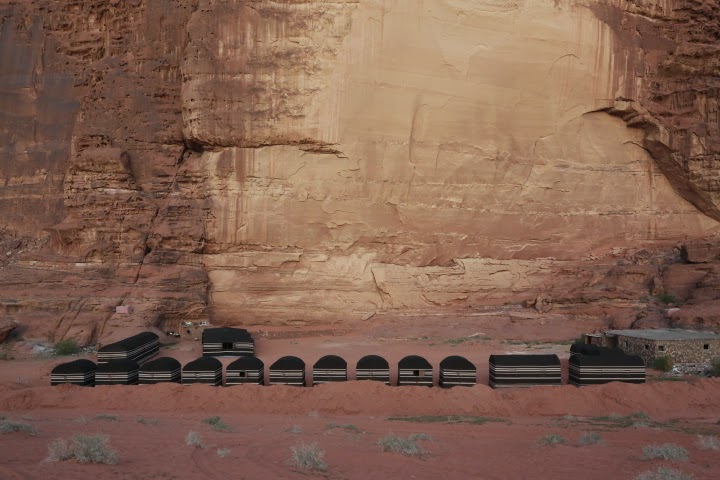
The Camp was a rather stolid looking place, with a row of tents for sleeping that faced the 150 foot cliff, a wondrous piece of geology in itself, with the communal eating and gathering tent on the left, and the communal bathroom & showers on the right.


After settling in the first order of business was to pile everyone at the camp into the four 4x4s and head off to see the sunset. Riding over the tire tracks in the sand at about 30 mph, the Bedouin drivers showed off by standing on their running board while steering, which confirmed a kind of wild-West feel to the place. The sunset viewing site was a gently sloping rock with fantastic geological flourishes all around. I found them irresistable and immediately set out to frame them into compositions. This was only the beginning of my romance with the rock formations of the Jordanian desert, which would culminate four days later in Petra. They looked like sinister frozen drips, casting shadows on the recessed surfaces behind. They mad me think at times of the style of H. R. Giger, of Gustave Moreau, of Edvard Munch, of Jean Dubuffet--not in the subject matter, of course, but in the rich chaos of their lines.

The cloudless sunset was magnificent.

That evening we all gathered in the communal tent for our dinner, but first there was traditional Bedouin music on the oud and silver drum. Two of our hosts got up and danced and then invited us to join them. Soon almost everyone in the room was up and dancing, having caught onto the simple step that made us feel as though we had been brought up in the community. 
Then we were all invited outside to see the meal in the "kitchen," but when we arrived there was just a low mound of sand. The cook proceeded to shovel the sand away, revealing a cloth that was removed, then a metal covering, underneath which was a three-tiered tray of our cooked food: chicken, caramelized onions, and potatoes. This was brought inside and served alongside several types of cut-up salads and the inevitable humus, always delicious and very smooth. I got to talking with three young women from Worcester, Massachusetts, one of whom was a budding photographer.


The following day Barbara and I took their all-day jeep tour of the desert, along with a couple from Vevey, Switzerland, Amanda and Benoit, and one from Bahrain & London, two English people, Josh and Lucy. We bounced along in the back of the truck, holding on for dear life, as our driver took us to seven magnificent desert spots, that included some astonishing Nabatean-era petroglyphs (2000+ years old), a sand dune we could "surf" down (but very laborious to climb up), a little shop selling desert and Dead Sea cosmetics and some beautiful fabrics alongside a wall that was a part of a dwelling that T. E. Lawrence had stayed in, two natural arches, and a narrow canyon with more ancient petroglyphs that had served as a refuge at various times in the past. And through it all the fantastic shapes on the rock faces looking like voracious abstract sculpture.


To be continued.


Friday, April 11, 2014

Cappadocia to Jordan

Back online after two days in Wadi Rum at the Bedouin Lifestyle Camp in the South of Jordan, where there was no Internet connection, then left my backpack with my tablet in it there, while we drove on to Petra. I was able to reach Attallah, the camp director by phone, and he had it sent to our hotel here in Wadi Musa, the town next to Petra, the following day, yesterday. I felt very stupid not to have counted all my luggage before leaving the Camp, but I also felt lucky that this happened in a place where I could easily get it back. So it was a cheap lesson to be a bit calmer when leaving someplace in a hurry to get back on the road by a certain hour.

Our last day in Cappadocia I made an hour-long visit to the local Art and History Museum, which also advertised itself as a doll museum. It turns out it presents the history of Turkey through several hundred extremely well-made dolls, created over 30 years by the curator's mother. I have visited many local folk museums in my travels, and every one has been a delightful discovery. This one was no exception. When I asked curator Serkan Paydak why he didn't publicize more, he said the local hotels wouldn't accept his brochure--which turned out to feature only his beautiful accommodation rooms and not the doll collection! I promised to write about the place.
Walking back to the hotel, we checked out and then drove about 25 miles south to the Keslik Monastery archaeological site. A Dutch couple we had met at the hotel had recommended this as an oustanding hiking spot. I was suffering from a cold that had come on me as a result of eating too much of the wonderful home-made jams they served us at the Old Greek House the first morning we were there. These jams were an extension of the dried fruit culture that flourishes in Turkey like no place else. Entire shops are devoted to it. I couldn't resist, and now I was paying the price.
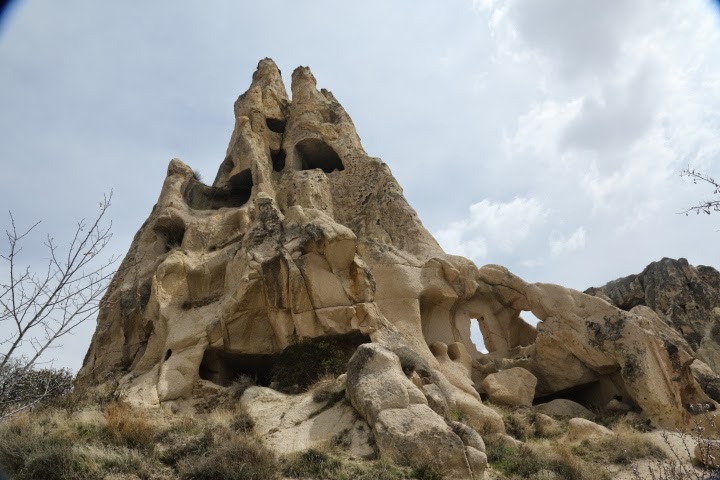
Undaunted, we followed a rather muddy path alongside magnificent 30-foot-high tent rocks about a mile in, until Barbara turned left to climb a rather steep embankment with uncertain footing on sandy soil with tufts of grass. We found our way to the top, about 50 feet off the ground, and were now looking down at the tent rocks. Across a gap about 300 yards away we noticed three people harvesting hay in a field as high as we were. We explored our elevated terrain, going up and down, thinking at one point that we had found a way down closer to our original starting point. In the process we discovered chambers hollowed out in the rock that seemed to be used mostly as dovecotes: rows of niches in the wall facing windows hewn out of the rock, straw on the floor. We had no idea how old they were.
Eventually we found our way down, only to discover that we were right back where we had first made the climb, so we had to walk the whole way back to the Monastery.
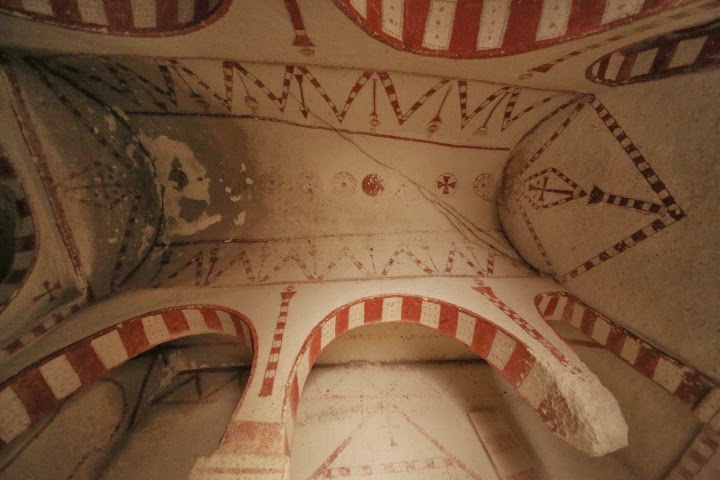
There Barbara worked on her writing, while I paid the 5 lira and visited the Monastery, falling in with a group of modern women (no headscarves, makeup), who turned out to be from Istanbul taking a vacation together. The Monastery dates from the Byzantine era, possibly the 11th Century, and is hewn out of the soft volcanic tuff stone that prevails in Cappadocia. It was actively used until the 1920s!
The Monastery curator was giving the tour himself--but it was in Turkish! No matter: he knew where the important figures were in the ceiling frescoes and shined his light on them. I had brought my headlamp and was able to get good photos--I never would have found so many on my own. One of the women was the editor of the weekend edition of an Istanbul newspaper and was interested in our trip; another was a travel agent who spoke French with me. I took a group photo of them where the light was particularly flattering.

Above the tent rocks

Inside Keslik Monastery


 A fresco of Jesus illuminated by my headlamp

The five women from Istanbul, whose tour I listened in on--in Turkish

The Mustafa Kemal (Ataturk) doll, presiding over the signing of the independence of Turkey.

Curator Serkan Paydak of the Art and History Museum of Mustafapasha, left, with his mother, the artist who made all the dolls over a 30-year period, right, with their house helper, center.
 Closeup of Mehmet II doll, the conqueror of Constantinople in May, 1453. Many Turks believe he acted benignly towards the civilian population. My sources say it was a bloodbath.

The litter of a Sultana. There a many wonderful ensemble scenes in the museum.

After relaxing at the open-air cafe with the women from Istanbul, where the Monastery curator plied us with tea, Barbara and I drove the 40 miles back to Kayseri, where we had dinner in the food court of a very contemporary-looking mall, returned the car, and took the 9 pm bus back to Istanbul. The fast-food restaurant we chose at the food court served us a delicious Turkish dinner of kebabs, humus and a form of tabouleh salad with a tasty seasoning that was new to me. This fast-food chain has not reached the New World yet.
We did our best to sleep on the bus, arriving at the Istanbul Otogar (bus depot) after a seemingly interminable drive through the monotonous urban sprawl of the city during morning rush hour. Our plane didn't leave until 2:30, but we didn't have enough time to run back to the historical district to see the Archaeological Museum we had missed on Wednesday.
The two-hour flight on Royal Jordanian Airlines (they couldn't have called it Air Jordan, since this is too close to the athletic shoe) was a delight. We received a full dinner--unheard of on such a short flight on airlines based in the US, and arrive on time at the Amman airport, where we changed money (the Jordanian dinar is worth about $1.43 or more, depending on where you exchange it) so we could pay our 40 dinar visa fee (!), which had recently doubled, we were told. We caught a cab to the Mariam hotel in nearby Madaba, a town that's closer to the airport than Amman, for our single night before picking up our car and heading for Wadi Rum in the south of the country, about 4 hours away.


Sunday, April 6, 2014

2nd Two in Cappadocia

Waiting in the Kayseri bus station for our 9 pm overnight bus back to Istanbul, Cappadocia is gradually receding into dream memory status. Everything turned out to be easy and hassle-free, with just enough of the modern world to keep us in contact with our home base, but I don't remember seeing a TV in three days! There was certainly none in our room (and we didn`t have to pay extra for that convenience!), none in the restaurants; none in the fast food establishments. Note that fast food in Cappadocia consists of a man making a sandwich from scratch for you. Even in a more updated city like Kayseri, the national fast food chains offer healthy, tasty food for the Turkish pallette, e.g. chicken kabob on Turkish bread (no whole wheat...), with onions, cabbage, rice pilaf and an Italian pepper on the side. Water (Turk. "Su") must always be purchased. And the home-made jams were so good at our hotel in this country where dried fruit appears to have been invented, that I ate too much of it the first morning we were there, and developed the sniffles by the third day from the sugar.
So yesterday we visited the famous "underground cities." These were actually huge multi-story shelters for entire regional populations to keep them safe for up to six months from invaders. They went as deep as eight six-foot stories, with hewn-out cublicles for each family, communal rooms for each social class, water supplies, waste disposal, ventilation, and a church during Christian times. But the original underground cities go back 4000 years and more. The volcanic tuff (or tufa) is soft enough to carve into rather easily. In one of them there were two stories dug when the Christians arrived, and they added 4-5 more. They were sealed with 8-ton doors in the shape of a 6-foot diameter while, like a grind stone on its edge, which could be rolled on a track through a fitted slit in the rock, and which could not be budged from the outside. Lookouts gave news of the presence or departure of the invaders. The cities were even connected by tunnels 10 km long and more, rather dismal passages one had to negotiate in a crouched position the whole way.
Leaving the second underground city we headed for the gorge of Ihlara, a 14km long river gorge with 100-foot walls, into which are carved refuges, dwellings and small churches, some with elaborate frescoes. One is always in search of frescoes in these 6th to 9th century remnants of early Christianity. Unfortunately most of them out in the "wild," that is, unrestored and unprotected, are heavily defaced, with the grafitti of ages. It was a delightful hike through this magical gorge, and we turned around after 4 km. Then we jumped in our car and headed for the other end of the gorge, the town of Selime, that boased a "troglodyte village." This was a number of dwellings carved into the conical rocks, including a church with simple and mostly effaced linear frescoes, none of the polychrome storytelling we had seen at the Goreme Open-Air Museum the day before.
To be continued.

Friday, April 4, 2014

Cappadocia, First Full Day Begins with Balloon Ride

I had made the reservation in early February, choosing the deluxe ride, 1.5 hours, but I was the only one for that ride this morning, so they asked me to take the standard one-hour ride, which turned out to be plenty.
But it was thrilling.
They picked me up at 5 am sharp, provided a minimal breakfast, and took us out to the site, where the balloon was filling with hot air. I was with 8 other passengers, all from Jakarta. We were crammed in rather tightly, but we got along fine, and I managed to switch positions half-way through the flight.
We were aloft before dawn, along with about 50 other balloons.

As the sun rose,  it dramatically illuminated the pinnacles on the ground.

We drifted over this incredible terrain in silence except for the periodic roar of the burner, and the end of an hour, our pilot Mustafa, landed us softly on the back of the company's flatbed truck. Mimosas and flight certificates awaited us on the ground, and I got back to the hotel by  8am in time to join Barbara for a REAL breakfast, with two cheeses, three marmelades, a cheese-filled pancake and halvah--a bit sugar-heavy for my habits, but I took it as a celebration of finally having arrived in Cappadocia.


We were out by 10am and gave ourselves the task of covering the Urgup-Goreme-Love Valley-Cavusin-Pasabaglari circuit, directly to our north, that included dozens of pre-1st millenium churches carved out of the soft tuff rock, and cap rocks and pinnacles of a distinctly phallic cast (hence "Love Valley") ending up exhausted in Urgup for an exceptionally good dinner at Somine, 

5th to 7th Century churches carved out of the soft tuff rock, decorated in frescos, many of which were defaced, presumably by the Turkish invaders.


One of the natural structures of the Goreme Outdoor Museum, a walking circuit of early churches all in the same park-like area.

One of the outstanding frescoes at the Goreme Outdoor Museum.

Prominent examples of the pinncles of Love Valley, which we dubbed the Five Horny Imams:


Thursday, April 3, 2014

Relics

Thursday, April 4
Relics
In case you were wondering what happened to Moses' famous staff, the one that turned into a
snake that ate the snakes of the staffs of Pharoah's magicians, I saw it yesterday(13th Century). It's one of the relics
enshrined in Istanbul's Topkapi museum, the former Sultans' palace and compound, Turkey's version
of the Louvre or the Forbidden City. And that same room also houses the "Prophet" David's sword (10th
Century BCE) with a metal tablet purporting to offer authentication in a language entirely strange to me;
and the "Prophet" Joseph's turban (14th century BCE), exceptionally well-preserved for fabric--and
who knew he sported a turban? There's also a footprint of the Prophet Mohammed, in what looks like
glazed mud. Topkapi consists of a sprawling walled compound, pleasantly landscaped with masses of tulips
grouped by color, and fragrant hyacinths, within which are a variety of buildings housing the treasures,
that one visits by following the crowd around, looking into recessed glass display cases. From the bejeweled
items one sees there in profusion, it's clear that the Sultans denied themselves nothing, and one
speculates that the "sick man of Europe," the Ottoman Empire, choked on its gemstones.
Hagia Sophia was both magnificent and deeply moving. One of the great architectural creations of the
earliest Middle Ages (the present building, the third version of it, dates from the 6th century CE) it retains
its solemnity, while displaying none of the decorative excesses associated today with the Eastern Orthodoc
Church, its direct descendant, although much of the original decor is gone. Kemal secularized it in 1935--the
Turks had made it a mosque after the conquest in 1453. Kemal's seated statue glowers over the adjoining park.
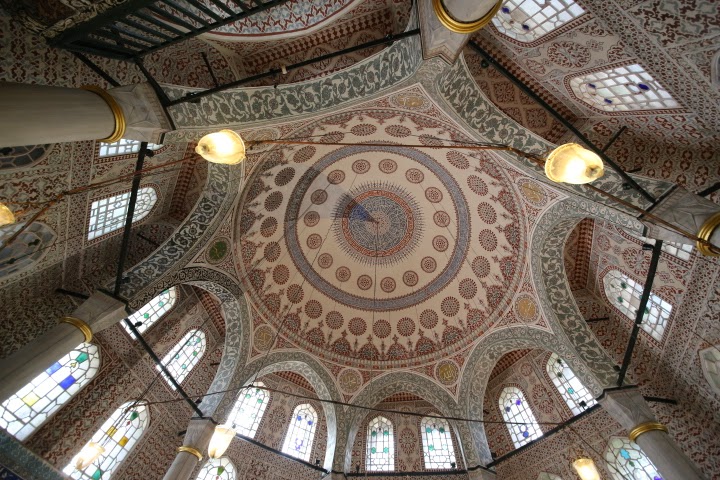
Islamic piety is quite in evidence, however. The magnificent Blue Mosque, part of the same complex,
issues you plastic bags for your shoes and a sky-blue cloth to women for a head covering, and has a
separate entrance for tourists from the one reserved for the faithful who've come to pray. Also, one
hears the call to prayer sung out over loudspeaker several times a day.
The local people were quite cordial. Merchants, of course, declared themselves our friends and guides, until
the moment when we said we weren't interested in visiting their shops. But those whose cafes or
restaurants we did patronize became our putative lifelong buddies. We snacked at a cafe overlooking the Blue
Mosque on one side and the Sea of Marmara on the other, both views unobstructed, and we dined
in the rich decor of a excellent restaurant, whose owner also had a business making and restoring
carpets. He had shown us his balcony earlier in the day--more great views.
After dinner we found our way back to our hotel after going in circles a few times, but finally were helpe
by a man towing a huge two-wheeled cart, fully loaded, and who refused a tip. Then we took a cab
to the bus station and boarded our midnight bus for Kayseri, near Cappadocia. Sleeping on it was more
comfortable than the airplane, since we had  more room. We arrived at 1:30 Thursday, and were met
by our car rental guy, with our car, which we drove to Urgup, a beehive of tourism, and full of the typical
rocks of Cappadocia, with dwelling carved into them, only to find that our hotel, The Old Greek House,
was a further 5 km down the road in the village of Mustaphapasha. I insisted on keeping our
reservation, and it was well worth it: it's an 18th century palace turned guest house, with rustic decor and
fabulous meals. Martha Stewart stayed there in 2010.

The Blue Mosque, ceiling

Hagia Sophia

Hagia Sophia

On Uncle Kemal's knees

Blue Mosque, after dark
Lunch at a rest stop outside of Kayseri
Old Greek House, Mustaphapasha, Turkey

Wednesday, April 2, 2014

Istanbul! We Both Got Here!

I left the house by cab for the train station at 2:15 and got to JFK by 4:15--easy. The plane was supposed to take off at 6:50, but we didn't leave the ground until 9:38, arriving at Ataturk Airport in Istanbul at 2:38pm the next day, local time. I had managed to watch "The Best Exotic Marigold Hotel" in two shifts, with about 4 hours of fitful sleep, always in search of a comfortable position. The movie was extremely apt, for reasons I'd realize later. Service and food were excellent on this Turkish Airlines flight, and they trumpeted their award as the "Best European Airline" on their menu (!).
But the waiting ordeal had just begun. I had imagined that I could run into town and see the Archaeological Museum and return to the airport by 6 in time to meet Barbara, who was supposed to arrive at 5:15 (and then go through customs for 45 minutes). But her plane turned out to be more than 6 hours late. I was getting smellier and smellier and more and more tired as I tried in vain for 4 hours to find out when her plane was expected to arrive. But her London originating flight was just marked "Delayed" in English and Turkish for hours; no one knew anything. Finally at about 10pm her expected arrival time showed up as 23:29, or about 11:30 pm. We had agreed we would take an overnight bus to Kayseri that night to begin our visit to Cappadocia, but no one in the airport had a bus schedule, so at about 8:45 I decided to take the metro to the Otogar, or bus depot, to find out. 
I grabbed all three of my bags, plus my plastic food bag, and off I went to the metro, bearing one backpack and dragging two rolling bags, one quite large. Inside the subway train the bigger one at 28 inches, kept keeling over, and I was glad it didn't hit anyone. When I got to the stop two young men tried to take my luggage, asking me my bus destination. I held onto it for a while, while they led me to the bus company that served Kayseri. I had expected a centralized depot. Instead, it was a row of colorful storefronts, so it turns out the two young men were actually helpful. Inside I found out that there was a midnight bus, arriving in Kayseri, Cappadocia, at 10 the next morning. The owner begged me to leave my two rolling bags with him, but I wouldn't think of it, since although Barbara's arrival was predicted at 11pm, I had no assurance that she would be her by then.
The two young men escorted me back to the subway station, repeating "baksheesh, baksheesh," and I assured them that I understood that a tip was the whole point of the exercise. However, I had no small bills, and only one Turkish lira in change, plus my return subway token. 
"No problem, no problem," they said when I revealed that my smallest bill was a 50 lira note, about $27. "Change, change," was their other English word. They offered to give me 30 lira in change, but I refused. Then they found a friend who contributed an additional 10 lira in coins, but I still refused. None of the merchants we tried in the metro station had change for the 50, so I had to give them the subway token (worth 3 lira) and the 1 lira in coins. The meaner of the two then shook his fist and scowled at me; I had betrayed them, but they had also left me with the necessity to find change for my 50. In the rear of the station a merchant took two 20s and a 10 out his wallet for my 50--the token machines wouldn't take anything larger than a 20, so I could buy my token.
Back at the airport by 10pm, Barbara's plane was finally announced at 23:29. By 11, I had decided to change our car rental reservation in Kayseri, moving it up a day, and to find a hotel in Istanbul, which I did with my Rough Guide to Turkey in my Kindle viewer in my tablet--a boutique hostel-hotel in the Sultanahmet district, where the main historical buildings were located--Hagia Sophia, the Blue Mosque, etc.
The announcement that Barbara's plane had landed came at 11:11. Now it would take her 45 minutes to get through customs. I had been calling and texting her for the past six hours, but with no response. I got up to wait with all the limo drivers at the arrivals door at about 11:30. By midnight she still hadn't appeared. I was beginning to wonder if I could do the trip on my own, if it had all been a hoax; I was extremely tired and smelly, but I did manage to banish those thoughts. 
Then, finally, after seven and a half hours in the airport, she appeared. We recognized each other immediately and greet each other like old friends. The trip would go on as scheduled (more or less--given uncertainties like today's). She changed money, and we headed for the metro, but were met by a kind taxi driver who informed us it was closed for the night. He offered to take us to our hotel for 65 lira, and we jumped at it.
We sped through the city, with the Sea of Marmara on our right, and the very European lights of the city on our left, passing through the ruins of Constantinople's fortified wall, and arriving at the Big Apple Hostel-Hotel on a sloping street within view of Hagia Sophia's minarets. The young proprietor's name was Apo, hence the name, and he was right out of "The Best Exotic Marigold Hotel," and here we were, past retirement age (though still working our asses off) having just met on the physical plane, and sharing a room with two beds. 
I set my camera up on the rooftop terrace before showering off the sweat of the voyage, while Barbara went directly to sleep. It was delicious extending my legs in a real bed.

The minarets of Hagia Sophia from the hotel terrace:

This morning dawned overcast, but I had gotten a good night and morning photograph from the same position. I took my camera down at 7:50, and then went back to sleep. The breakfast, which we at at 9:30, was quite extensive.

The view of the Sea of Marmara from the hotel cafe, with Barbara working on her blog in the foreground (rtwin70days.com).